
TABULA Building Typologies - Country Pages
A number of residential building typologies have been developed on the basis of the TABULA concept. For each country a summary of the results can be found at the respective country page (click on flag below). Explanations of the items on the country pages are explained in the text below.
Direct access to the "Country Pages":
| at | be | cz | de | dk | es | fr | gr | ie | it | pl | rs | se | si |
National Building Typologies - Explanations and Examples
In the following the elements of the national building typologies which can be found on the country pages are explained. The basics of the TABULA concept for building typologies are described in the TABULA Synthesis Report SR1 .
Classification of National Residential Building Stocks
The parameters for classification of residential buildings according to the TABULA concept are:
- the country
- the region or climate zone, if available
- the construction year class
- the building size class
- an additional parameter
A code system is used for identification of the building types.
Building Type Matrix
An overview of the national building typology is given by the "Building Type Matrix". The columns of the matrix are representing different building sizes, the rows different construction periods.
![]()
Classification Grid
The cells of the grid define the "Building Types" of a country. According to the TABULA concept there are 4 building size classes and a certain number of construction year classes. The start year and end year of the construction year classes are individually defined for each country.
![]()
Example Buildings
To each building type of a country (cell of the classification grid) an example building is assigned which is represented by a photo and the data of the thermal envelope. The example building is supposed to be a typical representative of the building type, meaning that it has features which can commonly be found in houses of the respective age and size class. The envelope area and the heat transfer coefficient of the example building are not necessarily representative in a statical sense.
For the question of "average buildings" see below in chapter "Models of the National Building Stock".
Definition of Example Buildings / Construction Elements / Supply Systems
In order to enable an energy balance calculation for the example buildings the respective datasets of construction elements, envelope areas and different supply systems are collected in a common database for each country (Excel workbook TABULA.xls). In case that definitions of the national EPC procedure differs from the TABULA data structure a data transformation must be applied.
In consequence, always two versions of the example building and supply system data are existing:
- Data according to the national EPC procedure
used in the national context for analyses, typology brochures, default datasets in EPC software, ... - Data according to the TABULA data structure
used to understand and compare the energy performance and refurbishment measures of buildings from different countries, e.g. within the frame of showcase analyses (TABULA WebTool) or cross-border building stock models
(see page TABULA Typology Structure - Concept)
Exemplary sheets of the TABULA database: datasets of ...
construction elements, ...
example buildings, ...
... and supply systems.
(Screenshots TABULA.xls)
Refurbishment Measures
The collected set of real buildings serve as showcase examples to demonstrate the effect of refurbishment measures. There are three variants of each building:- "Existing State":
typical state of a non-refurbished building - "Usual Refurbishment":
package of measures for upgrading the thermal envelope and the heat supply system
which are commonly realised during renovation; - "Advanced Refurbishment":
package of measures for upgrading the thermal envelope and the heat supply system
which are usually only realised in very ambitious renovations or research projects.
Calculation Procedure
The energy demand is determined for the three variants by use of a simple energy performance calculation procedure based on the respective CEN standards. The basics of the procedure are tabled on the page TABULA Typology Structure - Concept. The calculation sheets are shown in the pictures below. Due to the few numbers of calculation formulas an implementation in form of a spreadsheet (1 row for each building) can easily be performed. In consequence a large number of building and system variants can be calculated in a fast and transparent way.
In order to enable realistic statements as regards energy performance indicators and energy savings the ratio of typical levels of measured consumption to the standard calculation should be determined or estimated for each country. In case of estimations the calibration to the typical level of consumption is deemed preliminary - up to the time when statistical analyses of the correlation have been performed.
Calculation sheets (example building):
Energy need for heating
Standard Reference Calculation - based on: EN ISO 13790 / seasonal method
The energy need for heating is calculated by applying standard boundary conditions and relevant national climate data.
Energy performance of the supply system
Standard Reference Calculation - based on: EN ISO 15316 / level B (tabled values)
Basis of the calculation are tabled values for heat generation, storage, distribution and auxiliary energy - each for space heating and domestic hot water. The respective values for these system components have been determined for each country by use of the relevant national EPC methods and entered into the TABULA database.
Assessment of Energywares
Determination of the
- total primary energy demand
- non-renewable primary energy demand
- carbon dioxide emissions
- energy costs
by multiplying the delivered energy by energy carriers with the respective European or national factors.
The standard reference calculation is calibrated to the typical level of measured consumption - as far as information about the correlation is available for the different countries. The calibration factor describes the ratio of the energy uses determined by measurements for a large number of buildings and the energy uses determined by the TABULA method for the given value of the TABULA method.
National Typology Brochures
For each country a brochure has been eleaborated which contains the following elements:
- classification of the national building stock / display of the building type matrix
- frequencies of the building types
- typical energy consumption values of examplary buildings
- effect of refurbishment measures
- building display sheets
Each brochure is written in the language of the respective country.
Exemplary building display sheets
![]()
Italy
Belgium
Greece
Austria
Germany
Building Typology WebTool
The TABULA WebTool is designed to visualize the national building typologies. It showcases the energy consumption of typical buildings of a selected country and the effect of energy saving measures on the two levels "Standard" and "Advanced". All above mentioned elements are part of the online tool.
The expert version gives access to the underlying data (see WebTool menue Calculation Details / Open Expert Version).
![]()
A webtool user guide can be donloaded here: TABULA_WebTool_UserGuide.pdf
The building and system datasets will continuously be evaluated and improved. Feedback is welcome.
Statistics of Buildings and Heat Supply Systems
In order to assess the relevance of the building types and as a pre-requisite for the design of building stock models the available statistics are reported for each country. The basic statistics are giving account of the frequencies of building types and supply system types. Information about the energy related properties, current refurbishment grades and annual rates of refurbishment is added - as far as available.
More details about the concept and the structure of the statistical tables can be found in the TABULA Synthesis Report SR1 chapter 6.
Models of the National Building Stock
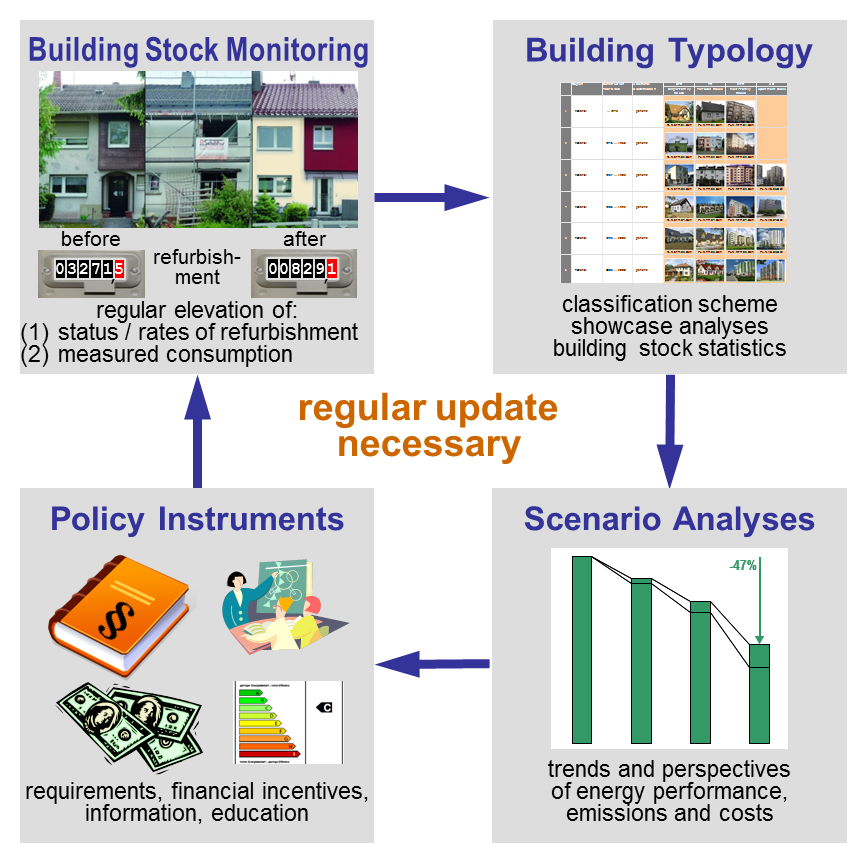
One important objective of the set-up of national building typologies is the elaboration of bottom-up models which enable a calculation of the energy consumption of the national building stock. A typical application field is the investigation of energy saving potentials for a national or regional building stock and the ex post and ex ante evaluation of instruments and political strategies.
The elaborated set of example buildings, as shown above, can be used directly as a building stock balance model - as far as statistics are available for the frequencies of building types and system types and for the refurbishment state. The example buildings can be considered as a small random sample. It is also possible to merge several classes and derive a small number of “average buildings”. As a consequence the implementation of scenario analyses – which implicates the variation of a large number of parameter combinations (e.g. differetn insulation measures, supply system upgrades) – is much more easy.
A further way to set-up building stock models is to elaborate "average buildings" on the basis of statistical analyses. The basis can be random samples (or a census in the best case) collected by surveys or from EPC databases. For some countries average buildings have already been derived in the framework of the TABULA project. An access to these datasets is possible by the Expert Version of the TABULA WebTool (identification code contains "SyAv" for "Synthetical Average" in contrast to "ReEx" for real existing building).
National building stock models are at the moment being elaborated by some of the TABULA partners on the basis of the typology data. The results will soon be published at this website.
Last Updated (Wednesday, 07 December 2011 09:46)


COUNTRY PAGES